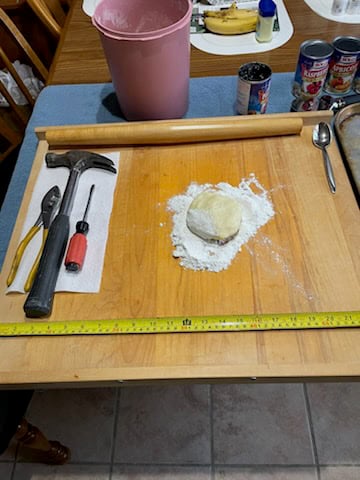
This year, I had to step onto a very different shop floor, the kitchen, to bake Christmas cookies for the grandkids. My wife had been an excellent baker, but was, unfortunately, taken from us by cancer two years ago. I’ve made it my mission to keep her traditions alive. And honestly, I figured, “I’m a trained engineer. How hard can cookies be?”
Naturally, I started digging for the ISO-approved work instructions. I quickly learned two things: handwritten recipes should be outlawed, and Polish-to-English translation requires both creativity and a calibrated sense of humor.
Like any factory, the first step is workplace readiness. Just like any Bill of Material, if you don’t have all the ingredients, you will not make a finished assembly. So, I studied the blueprint (Grandma’s recipe card) and built the process plan before starting production.
Certain operations definitely deserved a “CO” designation (controlled operation). For example, no one should be running a mixer after his or her first whiskey. And parameters matter. Ten minutes at 350 F is a good chocolate chip cookie; eleven minutes is a carbon-based reject. “Eh, close enough” is not a valid deviation request, especially when ½ cup of milk has somehow become ⅔ cup. In manufacturing or baking, that’s the difference between first-pass yield and total scrap.
And now, it’s time to use my statistical background and decide on the learning curve I wish to put myself on. First batch yield? Predictably low. So, in the design of experiments (DOE) phase, I launched a root-cause analysis using fishbone analysis, 5 Whys, 8D, AI, and, of course, CS (common sense), our most underutilized tool.
Turns out my cookies were splitting open because I issued too much material. The cookies split open and filling ran everywhere. Apparently, a TSP of filling is not the same as a TBS of filling. Material management was notified, and Batch Two showed significant improvement. By Batch Three, I was hitting near-spec perfection.
And the best part? Even with process hiccups, I still hit 100% customer satisfaction. Zero waste. Zero complaints. Full bellies. Happy grandkids.
There’s something oddly enjoyable about applying shop-floor thinking to home life. Safety matters everywhere. Following the process gets results. Training makes all the difference. And if you want true mastery? Spend time watching Mom or Grandma run their production line; they’re the original continuous-improvement leaders.
Because whether you’re machining aerospace components or rolling out sugar cookies, the fundamentals never change.