
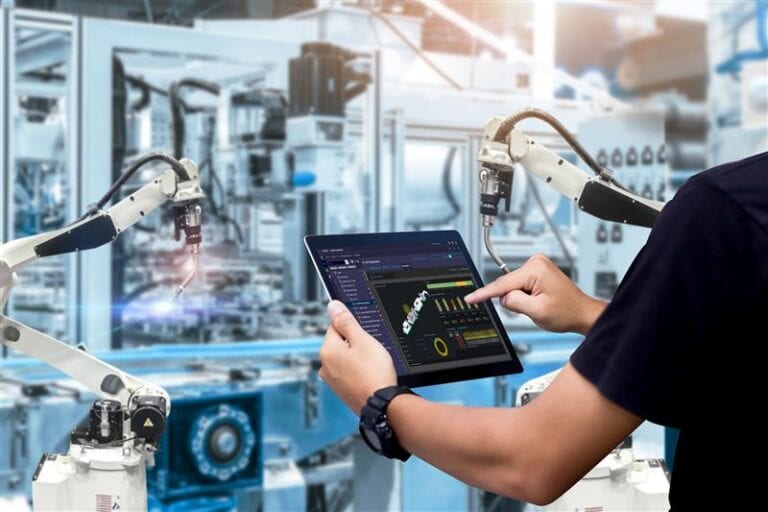
Imagine walking into your plant, and every machine from the stamping press to the CNC lathe could whisper its status into your ear. What would you hear? How many stories of potential failure, inefficiency, or opportunity are already in the data your machines collect, but no one is listening?
At Manufacturing Resource Network (MRN), we believe the future of manufacturing isn’t just about more machines or faster machines; it’s about getting every machine to tell you what it’s thinking before things go wrong. That’s the promise of predictive maintenance and advanced machine-data analytics software.
Here’s what your machines would tell you if they could, and what you, the CEO, should do about it.
- “I’m tired.”
Vibration sensors, motor current, and temperature spikes are subtle signs of fatigue. Without predictive maintenance, these show up only when a failure forces you to stop the line. Your machine is asking for preventive care: changing bearings, rebalancing loads, checking alignment. - “I’m working too hard or too inefficiently.”
Maybe the tooling is worn, which causes more waste or scrap. Perhaps cycle times are creeping up. The machine knows if every part takes a bit longer, or if the energy draw is creeping, or if it’s idling more than it should. These inefficiencies eat margins. - “I’m about to break.”
Before catastrophic failure (shaft fractures, bearing collapse, overheating, misalignment) there are telltale signatures: acoustic anomalies, micro-vibrations, heat gradients, oil contamination. If someone captured and analyzed that data, downtime becomes scheduled maintenance, not an emergency expense. - “You haven’t noticed patterns.”
Machines may show repeating trends (e.g. every three months a spindle overheats, or every time humidity is high, a sensor misreads). Alone, each event feels random. But with data collection over time and across machines, we can spot patterns, root causes, and implement systemic fixes. - “I’d like to help you forecast.”
What if your machine could tell you not just when it’s going to fail, but when production losses will mount, when safety risks increase, when there’s an opportunity to optimize for energy or throughput, or even do estimating? It’s not sci-fi; With enough data, machine learning, and good process knowledge, machines can enable you to forecast and plan with much greater accuracy.
Why CEOs Should Listen and Act
As a CEO, your focus is on growth, margins, reputation, and operational resiliency. Here’s how giving machines a voice advances those priorities:
- Reduced unplanned downtime = more predictable output & revenue. A sudden breakdown doesn’t just cost in repairs; it costs lost orders, delayed shipments, and unhappy customers.
- Lower maintenance costs over time. Reactive maintenance is expensive (urgent parts, overtime, expedited shipping), whereas predictive maintenance allows scheduling, negotiating, consolidating work, and often catching problems early before they become expensive.
- Improved quality & yield. Worn tooling or misaligned machines increase reject rates. Capturing early deviations means less scrap, less rework, fewer bottlenecks.
- Better capital allocation & investment planning. With data you can know which machines are dependable, which are aging, which are approaching useful life; so, you can invest in the right replacements or refurbishments, not react to crises.
- Risk management & safety. Many machine failures pose safety hazards. Monitoring anomalies can avert accidents. Plus, regulatory compliance, insurance, and reputation get strengthened when you show you’re proactively managing risks.
- Sustainability & energy efficiency. Machines running inefficiently burn more energy, cause more emissions, and waste resources. Data-driven optimization helps with cost savings and environmental goals.
What You Should Do to Hear Machines Loud and Clear
MRN helps manufacturing leaders turn “machine whispers” into actionable insights. Here are strategic steps CEOs should champion:
| Step | What To Do | Why It Matters |
| Audit your data infrastructure | Do you have sensors, gateways, networks capturing machine health, cycle times, and environment? Are they collecting the correct data (vibration, temperature, acoustic, oil quality)? | Without good data, insights are guesses. Investing in proper instrumentation and software sets the foundation. |
| Centralize & clean data | Bring together data from machines, operators, maintenance logs, environmental sensors. Clean it (remove noise, align timestamps). | Patterns usually span multiple data sources. Disconnected or dirty data leads to missed signals or false ones. |
| Invest in analytics & predictive tools | Use software and algorithms that can detect anomalies, trends, and predict failures. Perhaps start with pilot projects on critical machines. | Predicting a failure a week in advance beats reacting after the break. Pilots allow you to learn without risking everything. |
| Embed this into operations | Ensure maintenance teams, operators, and leaders have dashboards, alerts, and decision rights. Plan response protocols. | Data doesn’t matter unless it changes behavior. A good alert system + clear action plan = real value. |
| Continuous improvement & feedback | Review results, failure-events, and false positives. Ask: Did we catch it early? Did it stop failure? What needs tuning? | Predictive maintenance is not ‘set it and forget it’; it’s a journey. The more you refine, the more value you unlock. |
What MRN Brings to the Table
Here’s how MRN can help make sure your machines are speaking and you’re hearing:
- Interim & operations management: When you’re under pressure due to rising downtime or product defects, MRN can step in, set up real-time dashboards, establish predictive maintenance protocols, and stabilize operations.
- Manufacturing process improvement: We don’t just listen to machines; we look at entire process flows. Sometimes inefficiency comes from upstream or downstream, not just the failing part.
- Supply chain consulting: Spare parts, lead times, vendor relationships – all of these impact how effective predictive maintenance actually is. MRN helps ensure you can act efficiently when machines signal something is off.
- Project execution & change management: Implementing predictive maintenance means cultural and process shifts. MRN guides leadership through communication, training, pilot projects, and scaling.
What It Looks Like When Machines Are Talking—and You Are Listening
Here’s a hypothetical “day in the life,” adapted to what MRN often sees in client work:
It’s 9 a.m. The vibration sensor on one of your milling machines shows a small rise in frequency. The analytics tool flags an anomaly. Maintenance gets a notification: check spindle bearing. You review the alert, schedule a 30-minute inspection that afternoon. The bearing is replaced before any damage. That evening, production meets schedule; you avoid an unplanned stop that would’ve cost thousands in missed output.
Meanwhile, you review the dashboards weekly. On Machine Group B, cycle times have slowly crept up by 5% over two weeks. Tool wear is the cause; operator training and adjusted tooling reduce waste. Energy draw has increased 3%; you discover mechanical misalignment and adjust it. Net effect: more uptime, better quality, less costs all from listening in on what machines are trying to tell you.
In Summary
- Machines ARE communicating via data. The trick is building the ears and the brain to hear and interpret.
- Predictive maintenance is not just a maintenance strategy; it’s a business strategy for stability, cost control, quality, and growth.
- CEOs should lead the charge to support the investment, alignment, and culture shifts necessary.
- With MRN’s experience, you can transition from reactive to predictive by minimizing surprises and maximizing performance.
If your machines could talk, they’d tell you: “I want to help you succeed, but only if you listen.” As a CEO, your job isn’t just to hear them; it’s to respond. And when you do, the payoff is real. Let us share with you a solution we use with other clients to achieve this.